
Language
Views: 0 Author: Huipu Hand Dryer Technical Team Publish Time: 2026-06-23 Origin: Site


Hand dryers themselves are not inherently hygienic or unhygienic. Their actual hygiene performance depends on a variety of factors: the risk level of the facility, the hand-drying method, airflow design, daily maintenance procedures, and users’ actual behavioral habits.
For standard commercial restrooms, a well-designed sensor-activated hand dryer—featuring fast drying, controllable airflow, an easy-to-clean housing, and a reasonable maintenance plan—may be a viable solution. However, in high-risk environments such as healthcare facilities, food processing areas, daycare centers, nursing homes, or settings with strict hygiene standards, using paper towels or adopting a hybrid hand-drying solution may be a safer choice.
An inappropriate way to frame the question is:
“Are all hand dryers hygienic?”
A more appropriate way to frame the question would be:
“Given the risk level of a specific facility, does this particular hand dryer meet hygiene standards under the specified maintenance practices?”
This is the decision facility managers truly need to make.
Hand hygiene does not end when the faucet is turned off. Wet hands spread microorganisms more easily than dry hands; therefore, for this reason, the U.S. Centers for Disease Control and Prevention (CDC) explicitly states in its facts and guidelines on handwashing that it is essential to dry your hands thoroughly after washing. Hand-drying methods are an essential part of the hygiene system, not merely an accessory to restrooms.
For facility managers, the key issue is not whether “hand-drying equipment can remove moisture from the hands,” but whether “the system can dry hands quickly, reliably, and hygienically under the actual conditions of restroom use.”
This distinction is crucial because the behavior of actual users differs significantly from that of laboratory test subjects. If hand-drying equipment is slow, noisy, provides a poor user experience, is improperly installed, or causes users to wait in line, users may stop drying their hands before the process is complete. Even if a product performs exceptionally well under specific conditions, its performance advantages are meaningless if the actual results are poor due to users not completing the entire hand-drying process.
For this reason, reducing procurement decisions to a simple choice between “paper towels and hand dryers” is overly simplistic and lacks professionalism and rigor. A sound decision must comprehensively consider multiple factors, including facility conditions, equipment characteristics, cleaning procedures, and user behavior.
Current mainstream research on hand-drying methods varies in its focus. Some studies focus on the number of bacteria remaining on the hands, while others examine airborne dispersion, surface contamination, drying speed, or user preferences. A frequently cited review of different hand-drying methods concluded that most studies favor paper towels for efficient drying, bacterial removal, and reduced washroom contamination, especially where hygiene is critical. That is why the evidence should be interpreted by facility type rather than turned into a one-size-fits-all rule.
The University of Westminster conducted a study comparing paper towels, warm-air hand dryers, and jet-air hand dryers in a public restroom setting. The results showed that under experimental conditions, using paper towels reduced bacterial counts on the fingertips and palms, whereas warm-air and jet-air hand dryers increased them. The study also noted that jet-air hand dryers can disperse microorganisms up to 2 meters away from the unit, warm-air hand dryers disperse them approximately 0.25 meters, and paper towels showed no significant dispersion.
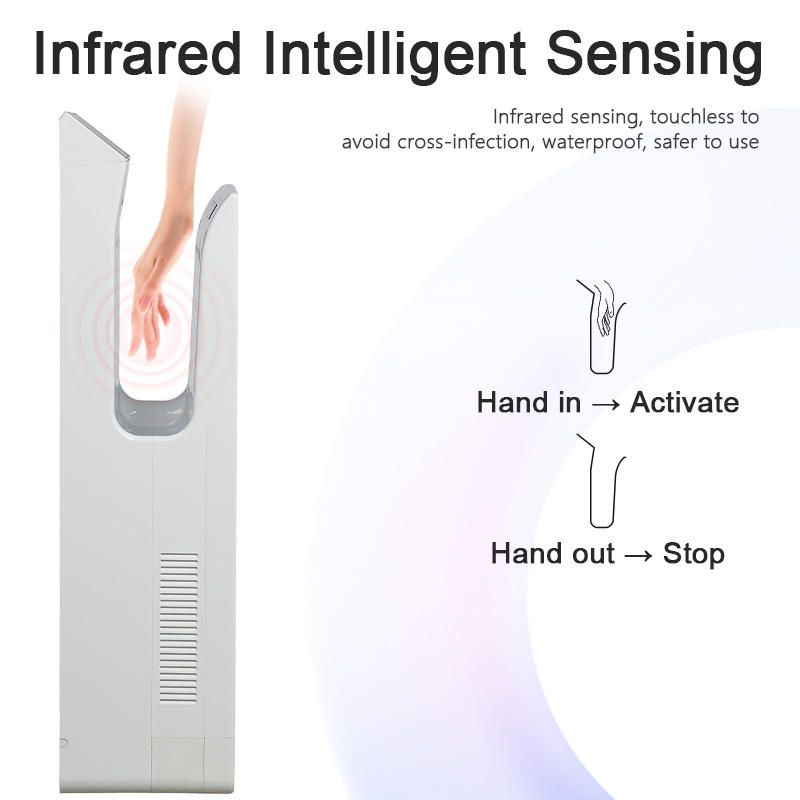
To address these contamination risks identified in traditional drying studies, modern commercial hand dryers incorporate touchless infrared activation and advanced air intake filtration to eliminate surface contact and minimize bacterial dispersion.

However, this does not mean that all currently available hand dryers are unsafe. Rather, it suggests that facility managers should not rely solely on airflow velocity as a key criterion for purchasing hand dryers. Airflow velocity, nozzle shape, hand position, air intake location, filtration systems, water drainage, and equipment maintenance status all influence the actual hygiene performance of these devices.
A useful way to read hand-drying research is to ask:
Research question | Why it matters for facility managers |
|---|---|
Does the method dry hands completely? | Damp hands can weaken hygiene performance. |
Does it reduce or increase bacteria on hands? | This affects direct touch transfer risk. |
Does it disperse droplets or microorganisms? | This affects nearby users and restroom surfaces |
What type of dryer was tested? | Warm air, jet air, HEPA, and UVC-assisted dryers may behave differently |
Was the dryer clean and maintained? | Maintenance affects airflow and hygiene performance |
Who funded the study? | Industry-funded studies should be read with context |
Was it a lab test or real washroom test? | Real use often differs from controlled conditions. |
The most responsible conclusion is not “all dryers are bad” or “all dryers are hygienic.” The evidence supports a more practical view: paper towels may be the safer choice in high-risk hygiene environments, while modern hand dryers can be suitable in many commercial restrooms if they are properly selected, installed, and maintained.
A facility manager should evaluate hand-drying hygiene through five factors.
Factor | What to evaluate | Why it matters |
|---|---|---|
Facility risk level | Office, school, restaurant, clinic, care home, airport, food prep area | Different spaces need different hygiene margins |
Drying method | Paper towel, warm air dryer, jet dryer, HEPA dryer, UVC-assisted dryer, hybrid system | Each method has different hygiene and operating trade-offs |
Airflow and equipment design | Intake location, nozzle geometry, air velocity, filtration, water path, housing cleanability | Hand dryers are airflow systems, not simple fixtures |
Maintenance routine | Filter replacement, air intake cleaning, sensor cleaning, drainage checks, service records | Poor maintenance can undermine good design |
User behavior | Drying completion, noise tolerance, queueing, hand position, accessibility | Hygiene depends on how people actually use the system |
This framework is more useful than a yes-or-no answer because it reflects how commercial restrooms actually operate.
A hand dryer is a compact airflow machine. Its hygiene performance depends on how air enters the unit, how air is accelerated, how it contacts wet hands, and where moisture goes after it leaves the skin.
A technical evaluation should look at the complete airflow and moisture path:
Where does the dryer pull air from?
Is the intake exposed to dust, lint, toilet plume, splash, or floor-level contamination?
Is incoming air filtered?
Is the filter properly sealed, or can air bypass it?
Does the nozzle direct air efficiently across the hands?
Does airflow push droplets downward, sideways, or back toward the user?
Does water collect inside the unit, below the unit, or on nearby surfaces?
Can staff clean the intake, outlet, housing, sensor, and service areas?
Does performance decline when filters load with dust?
Will users keep their hands in the airflow long enough to dry completely?
This is where many hand dryer articles are too shallow. They discuss “germs” as if the machine were a black box. In reality, dryer hygiene is an engineering question.
A dryer with poor intake placement, uncontrolled airflow, difficult filter access, and hidden moisture retention is a weak hygiene choice even if it is touchless. A dryer with controlled airflow, accessible filtration, cleanable surfaces, and realistic drying time is a stronger candidate for commercial use.
High air velocity can shorten drying time, and fast drying can improve user compliance. But air velocity is not the same as hygiene.
Very fast airflow can also increase splash, move droplets farther, create more noise, or make users pull their hands away too early. A dryer that looks impressive on a specification sheet may perform poorly in a school, clinic, office, or premium restroom if users find it too loud or uncomfortable.
The better question is not:
“How powerful is the dryer?”
The better question is:
“Does the airflow remove moisture efficiently without creating avoidable splash, noise, comfort, or contamination problems in this facility?”
A good commercial dryer specification should evaluate drying time, airflow control, nozzle geometry, filtration, noise, energy use, housing cleanability, service access, and real user behavior together.
HEPA filtration can be valuable because it helps filter air before it reaches the user’s hands. In restrooms where dust, lint, air quality, or perceived cleanliness are concerns, a properly designed HEPA dryer can be a better option than an unfiltered model.
But HEPA is not a magic hygiene label.
Facility managers should ask:
HEPA evaluation question | Why it matters |
|---|---|
What filter grade is used? | “Filtered air” is too vague for procurement |
Is the air path sealed? | Poor sealing allows air to bypass the filter |
How often must the filter be replaced? | A neglected filter loses practical value. |
Can staff access the filter easily? | Hard-to-replace filters are often ignored. |
Is there a filter status indicator? | Maintenance teams need a reminder.s |
What is the replacement cost? | Low purchase price can hide long-term cost |
Is the filter protected from splash and debris? | Restrooms are not clean-room environments. |
A HEPA hand dryer can support a more hygienic drying system, but only when filtration is part of a maintainable design.
Some hand dryers are equipped with UV lamps, air disinfection modules, plasma generators, antimicrobial coatings, or similar hygiene features. While these technologies may offer added value in certain specific designs, buyers should carefully review the test conditions.
Before accepting any hygiene claims, ask the following questions:
Were the tests conducted on the entire hand dryer, or only on a specific component?
Were the tests performed by an independent laboratory?
Which microorganisms were tested?
How long was the exposure time?
Do actual airflow conditions match the test conditions?
How will performance change as the lamp or components age?
What cleaning or replacement procedures are required?
Are these claims relevant to actual restroom usage?
As professionals, you should always keep in mind: UV light is no substitute for cleaning. Antimicrobial surfaces are no substitute for wiping. Air treatment is no substitute for thoroughly drying your hands. These features should be viewed as supplementary functions, not as reasons to neglect basic maintenance.
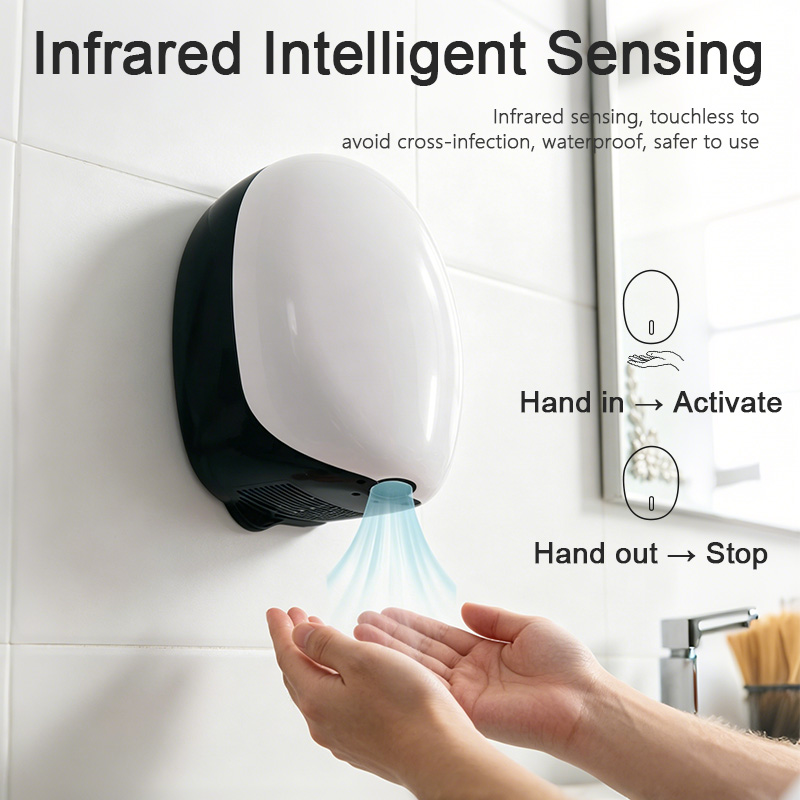
The touchless activation of hand dryers reduces direct contact between hands and the machine, which is particularly useful in high-traffic restrooms. However, a touchless design alone cannot completely solve hygiene issues.
If a touchless hand dryer suffers from issues such as slow drying, dirty air intakes, poorly sealed filters, moisture buildup, water splashing, or difficulty in cleaning, its hygiene performance may be unsatisfactory—even with the touchless feature.
This principle also applies to touchless paper towel dispensers. While reducing contact is beneficial, hygiene ultimately depends on consumable replenishment, waste disposal, surface cleaning, and user habits.
“Touchless” is merely a feature, while “hygiene” is a system.
The most hygienic solution is not the same for every building.
Facility type | Hygiene risk | Practical approach | Key reason |
|---|---|---|---|
Standard office restroom | Medium | Touchless fast dryer or hybrid system | Balance hygiene, cost, noise, and user experience |
School restroom | Medium | Quiet, durable, fast dryer or hybrid option | Children may avoid loud or forceful dryers |
Restaurant public restroom | Medium-high | Touchless dryer, paper towels, or hybrid | Customer perception and cleanliness matter |
Food preparation area | High | Follow food safety policy; paper towels may be preferred | Hygiene control and compliance are critical |
Healthcare or clinic restroom | High | Policy-led approach; paper towels are often the conservative option | Infection-control expectations are higher |
Care home or nursery | High | Conservative or hybrid approach | Vulnerable users require wider safety margins |
Airport or mall restroom | Medium-high | Fast, durable, easy-service dryer or hybrid | High traffic and maintenance workload matter |
Industrial facility | Medium | Durable dryer with easy cleaning and filter access | Dust, heavy use, and serviceability matter |
Premium commercial restroom | Medium | Quiet touchless dryer or premium towel system | User experience and brand perception matter |
For high-risk spaces, do not rely on product marketing alone. Follow internal hygiene policies and relevant local guidance. For standard commercial restrooms, a well-selected dryer can be appropriate if the design and maintenance plan are strong.
A hand dryer does not remain hygienic because it looked hygienic on installation day. It remains hygienic because it can be cleaned, inspected, serviced, and used correctly over time.
A maintenance review should include:
Maintenance item | Why it matters | What to check |
|---|---|---|
Air intake | Can collect dust, lint, and restroom debris | Intake should be visible and cleanable |
Filter | Performance depends on replacement | Filter should be easy to access and track |
Sensor area | Dirt can affect activation | Sensor should be easy to wipe |
Housing surface | Splash and dust settle on exterior | Smooth, cleanable materials are preferred |
Air outlet | Directs airflow onto hands | Outlet should not trap debris |
Drainage or water collection | Standing moisture can create odor and hygiene concerns | Tray or drainage area should be easy to clean |
Internal access | Hidden contamination is difficult to manage | Staff should be able to inspect service areas |
Installation location | Poor placement affects splash and use | Unit should fit actual traffic flow |
If a dryer is difficult to clean, it is a weak hygiene choice even if the brochure looks impressive. For a model-specific cleaning, filter, sensor, and service process, use our commercial hand dryer maintenance checklist.
Hand-drying solutions are effective only when people use them according to scientific guidelines.
Users may be in a hurry or find the noise from the equipment too loud; if they have to wait in line, they may simply walk away. Children may avoid hand dryers with overly strong airflow; and for office workers, if the hand dryer is too slow or provides a poor user experience, they may stop using it after just a few seconds.
Therefore, drying time, noise level, installation location, and ease of use all become key factors affecting the effectiveness of the equipment.
Excessively long drying times may leave users’ hands still damp; excessive noise may reduce usage rates; installation locations that are too close to sinks, entrances, or narrow passageways may cause congestion; and awkward hand positions during use may prevent hands from drying thoroughly.
The real question is:
“Will the majority of users at this location actually use the system to thoroughly dry their hands?”
If the answer is no, then no matter how impressive the system’s technical specifications may be, it is ultimately likely to fail.
The paper towel versus hand dryer debate is often framed as a hygiene fight. For facility managers, it is really a risk and operations decision.
Priority | Paper towels | Hand dryers | Hybrid system |
|---|---|---|---|
Maximum hygiene caution | Strong option, especially in high-risk settings | Depends heavily on dryer design and policy | Strong option when user choice is important |
Lower paper waste | Creates ongoing waste stream | Reduces paper waste | Reduces but does not eliminate waste |
Lower restocking workload | Requires frequent refilling | No towel restocking | Some restocking still required |
User preference | Often familiar and fast | Depends on speed, noise, and comfort | Gives users choice |
High-traffic durability | Bins and dispensers require management | Durable units can handle traffic well | Useful in busy locations |
Maintenance type | Refills, bins, surface cleaning | Cleaning, filter replacement, service checks | Requires both routines |
Perceived cleanliness | Strong when stocked and bins are clean | Strong when units are modern and clean | Strongest when managed well |
Operating cost | Ongoing towel and waste cost | Energy, maintenance, and possible filter cost | Mixed cost profile |
Choose paper towels when hygiene caution is the highest priority or policy requires them. Choose hand dryers when reducing waste, restocking labor, and consumables is important, and the facility can maintain the equipment. Choose a hybrid system when user preference, hygiene caution, and operational flexibility all matter.
A low-cost dryer can become expensive if it performs poorly in real use.
Facility managers should evaluate total cost of ownership, not just purchase price.
Cost category | What to consider |
|---|---|
Purchase price | Unit cost, installation hardware, electrical requirements |
Installation | Wiring, wall strength, placement, and code considerations |
Energy use | Wattage, drying time, and traffic volume |
Maintenance | Cleaning time, filter replacement, service access |
Downtime | Repairs, complaints, and temporary alternatives |
User experience | Noise, drying comfort, accessibility, and perceived cleanliness |
Waste management | If using towels or hybrid systems, include refill and disposal cost |
Lifespan | Motor quality, housing durability, warranty, and parts availability |
A cheap dryer with slow drying, high noise, poor filter access, and weak service support can create more operational friction than a better-designed commercial unit.
Before purchasing a hand dryer, pressure-test the supplier’s claims.
Claim | What to ask |
|---|---|
“Hygienic hand dryer” | What specific design features make it hygienic? |
“HEPA filtered air” | What filter grade is used, and how is bypass prevented? |
“Kills bacteria” | What test method, organism, exposure time, and lab were used? |
“Touchless” | Does the sensor work reliably in real restroom conditions? |
“Fast drying” | What drying time was tested, and with what method? |
“Low noise” | What decibel level, at what distance, and under what installation condition? |
“Eco-friendly” | Is the claim based on energy use only or a lifecycle comparison? |
“Low maintenance” | Which tasks are reduced, and which are still required? |
“Suitable for all facilities” | Which facility types were actually considered? |
“Antimicrobial surface” | Does it reduce cleaning needs, or is it only an added layer? |
If your hygiene requirements affect model configuration — such as HEPA filtration, UV-C options, housing material, airflow design, voltage, plug type, or maintenance access — the next step is to verify whether the supplier can actually manufacture, test, and support the right model. Before requesting samples or bulk pricing, review our guide on “How to Choose a Hand Dryer Manufacturer” for choosing a reliable commercial hand dryer manufacturer.
Before selecting a system, answer these questions:
Question | Why it matters |
|---|---|
What is the hygiene risk level of this facility? | High-risk spaces need wider safety margins |
Is the restroom high traffic? | Traffic affects queues, drying completion, and maintenance |
Will users fully dry their hands? | Incomplete drying weakens hygiene performance |
Is noise a concern? | Noise can reduce use and increase complaints |
Is the dryer touchless? | Fewer contact points can improve usability |
Does the dryer use HEPA filtration? | Filtration may improve incoming air quality |
Is the filter easy to replace? | Maintenance determines long-term performance |
Are UVC or sterilization claims documented? | Claims need test evidence |
Can cleaning staff access key areas? | Hard-to-clean designs create hidden risk |
Does the dryer manage water effectively? | Standing moisture can create odor and hygiene concerns |
Is the unit suitable for the user group? | Children, elderly users, and busy workers behave differently |
Is a hybrid system more appropriate? | Some facilities need user choice |
What is the total cost of ownership? | Purchase price alone is misleading |
Are replacement parts available? | Downtime affects restroom operations |
Can the supplier support facility-specific recommendations? | B2B decisions should not be generic |
If several answers are unclear, the facility is not ready to choose a product. It needs a drying strategy first.
Hand dryers can be hygienic in commercial restrooms when they are touchless, fast enough for complete drying, properly maintained, easy to clean, and suitable for the facility’s hygiene risk level. They should not be judged as a single category because design and maintenance vary widely.
Some studies suggest that certain air dryers can disperse microorganisms or droplets farther than paper towels. The real risk depends on dryer type, airflow design, filtration, maintenance, restroom layout, and user behavior.
Paper towels are often the more conservative choice in high-hygiene environments because they dry quickly and physically remove moisture. In standard commercial restrooms, a well-designed and well-maintained hand dryer may also be appropriate.
HEPA filtration can support hygiene by filtering air before it reaches the hands. However, the benefit depends on filter grade, seal quality, airflow path, and replacement schedule.
UVC or air sterilization features may add a layer of air treatment, but buyers should review test conditions, component lifespan, and maintenance requirements. UVC should not be treated as a replacement for cleaning.
There is no universal answer. High-risk facilities may prefer paper towels or policy-led solutions. Standard commercial restrooms may use modern hand dryers if they dry quickly, control airflow, reduce touch points, and can be maintained. Some facilities benefit most from a hybrid system.
Filter replacement depends on the dryer model, filter type, restroom traffic, and environmental dust. Facility managers should follow the manufacturer’s schedule and keep replacement records.
They can be, but schools should prioritize low noise, fast drying, durability, safety, and easy maintenance. Some children avoid loud or overly forceful dryers, so user behavior matters.
Healthcare and clinical facilities should follow internal infection-control policies and relevant guidance. In many high-hygiene environments, paper towels may be preferred as a conservative option.
A hybrid approach can help balance hygiene caution, user preference, waste reduction, and operational flexibility. It gives users a choice and can reduce complaints in mixed-use or high-traffic restrooms.
Hand dryers can certainly be hygienic, but only if they are selected and maintained as part of the facility’s overall hygiene system.
For facility managers, procurement decisions should begin with an assessment of the facility’s hygiene risks, rather than simply consulting product catalogs. The right solution depends on multiple factors: hygiene standards, user habits, restroom traffic, cleaning capabilities, equipment design, and overall operating costs.
A good hand-drying solution should address the following five questions:
Does it align with the facility’s hygiene risk profile?
Can users actually dry their hands thoroughly?
Is the airflow controlled? Is it filtered when necessary? Is the equipment easy to maintain?
Can the cleaning and maintenance teams ensure the system maintains optimal performance over the long term?
Does the solution strike the optimal balance between hygiene, cost, waste management, noise control, and user experience?
The most hygienic choice isn’t necessarily the one with the loudest marketing claims, but rather the one that operates reliably in your restroom environment, for your user group, and under your maintenance conditions.


