
Language
Views: 0 Author: Site Editor Publish Time: 2025-01-17 Origin: Site


A negative ion hair dryer uses an ion generator to release negatively charged ions into the airflow. These ions are designed to help reduce static electricity on the hair surface, which can make hair less flyaway and easier to manage.
But how do negative ions work in a hair dryer? How do they interact with hair, and what effects can you actually expect? Understanding the working principle of negative ion technology helps explain its real benefits and limitations.
In this guide, we will look at how negative ions are generated, how they are released through the airflow, and how they help reduce static electricity and frizz. We will also explain what this technology can and cannot do for your hair.
If you want to understand how negative ion technology fits into the complete hair dryer design, see our guide to what an ionic hair dryer is and how its main technologies work.
A negative ion is an atom or molecule that has gained one or more electrons, giving it a negative electrical charge. Unlike a neutral particle, a negative ion carries an extra electron and has a net negative charge.
This is the basic scientific meaning of a negative ion, as explained in the IUPAC definition of a negative ion.
In a negative ion hair dryer, an ion generator produces negatively charged ions and releases them into the airflow. These ions are intended to help reduce positive electrical charges that can build up on the hair surface during drying and brushing.
This is the main purpose of negative ion technology in hair dryers. By helping reduce static electricity, it can make hair less flyaway and easier to manage. The actual effect depends on the ion output and the conditions in which the hair dryer is used.

Negative ion technology in a hair dryer works through an electronic ion generator. In many designs, the generator uses high voltage and a small emission electrode to produce negatively charged ions. These ions are then released into the airflow and carried toward the hair.
The process can be understood in three steps:
1. Negative Ion Generation
When the hair dryer is switched on, the ion generator receives electrical power and creates a high voltage. This voltage is applied to a small emission electrode, preparing the conditions needed to generate negative ions.
2. High-Voltage Ionization and Corona Discharge
In many negative ion generators, this process uses a method called corona discharge. A strong electric field forms around the electrode, causing the air near its tip to become ionized.
During negative corona discharge, free electrons interact with nearby air molecules, especially oxygen molecules. Some of these molecules gain electrons and become negatively charged ions.
3. How Negative Ions Enter the Airflow
Once generated, the negative ions move away from the emission electrode and enter the outgoing airflow. The airflow carries them toward the hair, where they can interact with electrical charges on the hair surface.
The shape and placement of the ion emitter may vary depending on the internal design of a hair dryer. However, its basic function remains similar: to generate negative ions and release them into the airflow.
This is how a negative ion hair dryer delivers negatively charged ions to the hair.
From a hair dryer manufacturing perspective, the shape and position of the ion emitter can vary depending on the product's internal design. However, its main purpose remains the same: to generate negative ions and release them into the airflow. The actual ion output should be evaluated under defined testing conditions rather than judged by the appearance of the emitter alone.
The main purpose of negative ions in a hair dryer is to help reduce static electricity on the hair surface. Static charge can make hair strands repel each other, causing flyaways and making hair harder to manage. By helping reduce this charge, negative ion technology may improve the way hair looks and feels after drying.
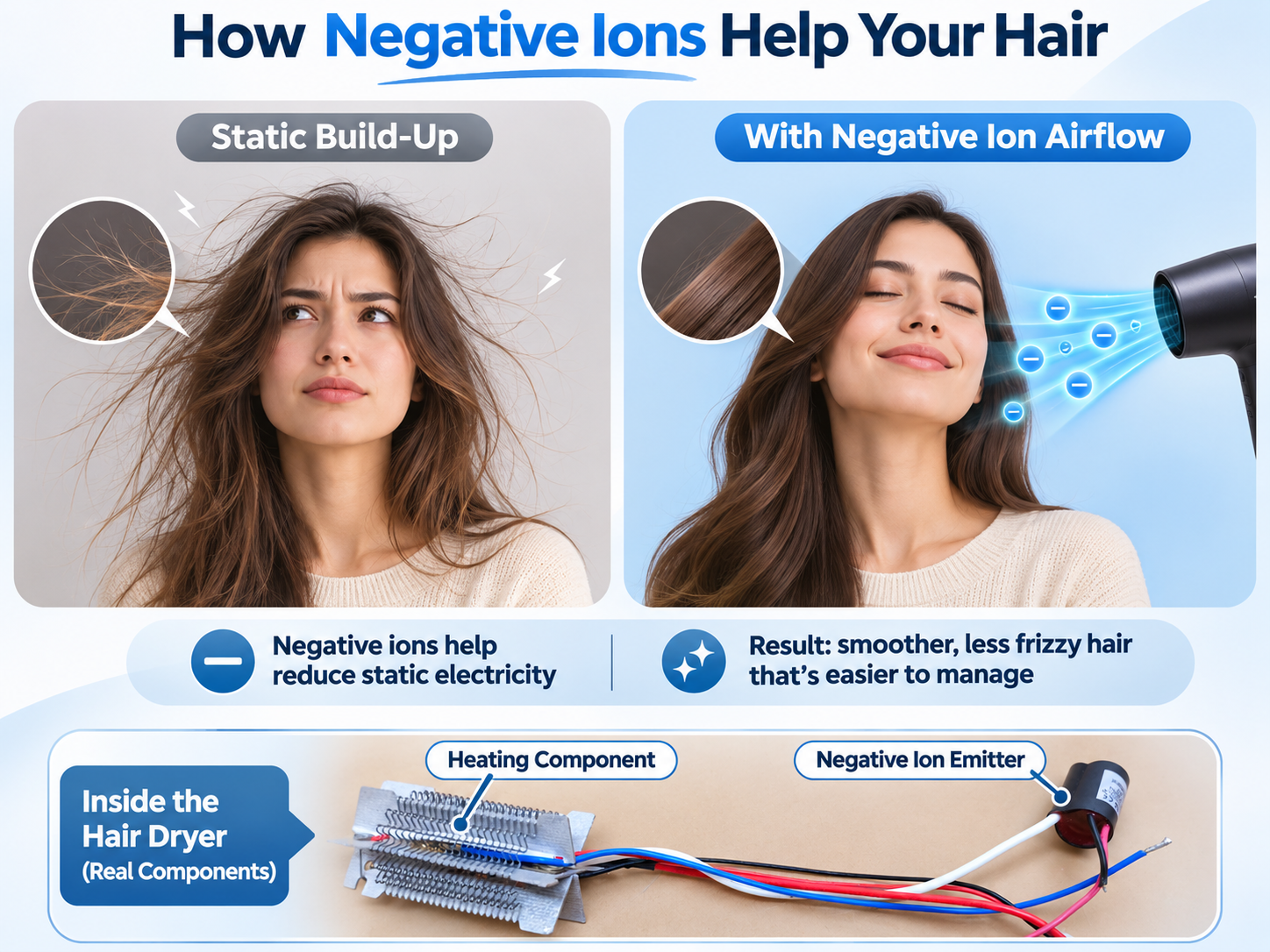
When hair rubs against other surfaces—such as hairbrushes, combs, towels, or clothing—static electricity may be generated. During this process, the electrical charge on the surface of the hair becomes unbalanced, and electrons are transferred between different materials—a process known as the “triboelectric effect.” Depending on the materials involved and specific conditions, the hair may become positively charged.
When nearby hair strands carry similar electrical charges, they can repel each other. This makes hair more likely to stand apart and become difficult to control.
Negative ions released by a hair dryer may help neutralize positive electrical charges on the hair surface. This can reduce static buildup and make individual strands easier to manage.
The effect can vary with hair condition, humidity, surface treatments, and the amount of static charge present before drying.
Flyaways are often linked to static electricity. When hair strands repel each other, they may spread apart instead of lying together in an orderly way.
By helping reduce static charge, negative ion technology can make hair less flyaway and easier to control after drying.
However, not all frizz is caused by static electricity. Hair damage, moisture conditions, surface roughness, and humidity can also affect how hair looks and behaves. Negative ions should therefore be understood as one way to help manage static-related frizz, not a complete solution for every type of frizz.
When static buildup is reduced, hair strands may lie closer together and become easier to comb and style. This can give hair a smoother and more orderly appearance.
However, a smoother appearance does not mean that negative ions have repaired damaged hair or permanently closed the hair cuticle.
Hair surface condition also plays an important role in smoothness and manageability. Chemical treatments, heat, and mechanical friction can affect the hair cuticle and increase friction between strands.
Negative ion technology mainly helps manage electrical charge. It should not be confused with conditioning ingredients or treatments that act directly on the hair surface.
Negative ion technology has a clear purpose in hair dryers: helping reduce static electricity on the hair surface. However, not every benefit claimed in product marketing can be directly linked to negative ions.
Understanding what this technology can and cannot do helps set realistic expectations.
The main intended benefit of negative ions is reducing static-related flyaways.
When negative ions interact with electrical charges on the hair surface, they may help reduce static buildup. This can make hair easier to manage and give it a smoother appearance after drying.
The actual result depends on several factors, including the hair's condition, the surrounding humidity, the drying process, and the ion output of the hair dryer.
Negative ions are often advertised as a way to shorten drying time. However, it is important to distinguish the effect of ion technology from the drying performance of the hair dryer itself.
Hair drying mainly depends on factors such as airflow, air temperature, and the amount of moisture that needs to be removed.
Negative ion output alone does not prove that a hair dryer will dry hair faster. A faster drying result should be demonstrated through controlled testing under comparable conditions.
No. Negative ions should not be described as a treatment that repairs damaged hair fibers.
Hair damage can affect the cuticle surface and increase friction between strands. Negative ion technology mainly helps manage electrical charge. It does not rebuild damaged hair structures or repair split ends.
Products containing conditioning ingredients may improve the feel and surface condition of hair, but this is a different process from generating negative ions.
Negative ions should not be confused with water or moisturizing ingredients.
An ion generator produces electrically charged particles in the air. It does not directly supply water to the hair or replace moisture lost during drying.
Claims about moisture replenishment or deep hydration therefore require separate evidence and should not be assumed to be a direct result of negative ion generation.
The presence of an ion generator does not automatically mean that every hair dryer delivers the same negative ion output.
Measured ion concentration can vary depending on the product design, operating conditions, measurement position, and test method.
In a 2023 test of 13 hair dryers, the Hong Kong Consumer Council found measured negative ion concentrations ranging from 361 to 89.9 million ions per cubic centimeter. It also found substantial differences between some manufacturers' claimed values and the measured results.
This shows why an ion concentration figure should not be considered reliable evidence on its own.
For a meaningful comparison, the measurement method, distance from the air outlet, operating settings, and testing conditions should also be stated.
A higher advertised number does not automatically mean better results on hair. The actual performance of negative ion technology needs to be evaluated under clear and comparable testing conditions.
Negative ion technology in hair dryers works by generating negatively charged ions and releasing them into the airflow. These ions may help reduce static electricity on the hair surface, making hair less flyaway and easier to manage.
Its main purpose is to help control static-related frizz and improve hair manageability. However, it should not be confused with a hair repair treatment or a direct source of moisture.
The actual performance of a negative ion hair dryer depends on its ion output, operating conditions, and the condition of the hair being dried.
Understanding how negative ions work, what they can do, and where their limitations lie provides a more reliable way to evaluate this technology.
If you are looking for hair dryers equipped with negative ion technology, explore our Negative Ion Hair Dryer Collection to see the available product options.


