
Language
Views: 0 Author: Site Editor Publish Time: 2025-04-11 Origin: Site


Professional hairdressers do not choose hair dryers only based on power or appearance. A salon hair dryer needs to deliver stable performance during repeated daily use, support different styling techniques, and provide a comfortable experience for stylists and clients.
The hair dryers used in professional salons are usually different from standard home models. Hairdressers often look for equipment with stronger airflow, reliable temperature control, durable components, and designs that can handle long working hours.
For salon owners, beauty equipment distributors, private label brands, and wholesale buyers, choosing the right hair dryer also involves additional factors such as voltage requirements, certifications, customization options, and supplier capability.
This guide explains what hair dryers professional hairdressers use, why certain models are preferred in salon environments, and what buyers should evaluate when sourcing professional salon hair dryers.
Professional salons usually select hair dryers based on four main factors:
| Selection Factor | Why It Matters |
|---|---|
| Performance | Stable airflow and heat output help stylists complete different services efficiently. |
| Durability | Salon equipment needs to handle frequent daily operation. |
| Ergonomic Design | Lightweight and comfortable designs reduce fatigue during long styling sessions. |
| Product Suitability | Different salon environments may require different dryer types and configurations. |
For most professional applications, hairdressers commonly use:
Professional handheld hair dryers for flexible styling and daily salon work.
Wall-mounted hair dryers for commercial spaces where organization and accessibility are important.
Salon dryer stands for specific treatments that require hands-free operation.
Choosing the right salon hair dryer involves more than comparing the dryer itself. Buyers also need to consider the target market, technical features, certifications, and customization needs.
A professional salon environment creates different demands compared with home use.
A consumer may use a hair dryer for several minutes each day. A hairstylist may use the same type of equipment repeatedly throughout a full working day. Because of this difference, professional hair dryers need to focus on consistency, durability, and control.
Salon hair dryers are designed for frequent use.
A professional stylist may need to dry, shape, or finish many different hair types in one day. The dryer needs to maintain stable airflow and temperature performance throughout repeated use.
For this reason, professional buyers usually pay attention to:
Motor performance
Heat stability
Product durability
Build quality
Maintenance requirements
A suitable salon hair dryer should not only perform well when new. It should also maintain reliable performance over long-term operation.
Hair styling requires more than fast drying.
Different hair types require different levels of airflow and heat. Fine hair, thick hair, curly hair, and chemically treated hair may need different styling approaches.
Professional hair dryers often include:
Multiple heat settings
Adjustable speed settings
Precision airflow control
Ionic technology options
These features allow stylists to adjust the drying process based on the service they provide.
Companies building salon styling tools product lines often evaluate whether temperature control and airflow stability are also important product positioning factors.
Hairdressers use dryers for extended periods, so comfort is an important consideration.
Professional buyers often evaluate:
Weight balance
Handle design
Noise level
Cable flexibility
Ease of operation
A well-designed dryer can improve the working experience for stylists and support more efficient salon operations.
For commercial users, these product details are just as important as power performance because they affect daily operation and user experience.
Professional salons use different types of hair dryers depending on their services, workspace layout, and customer requirements.
There is no single dryer type that fits every salon. A busy styling salon may prioritize flexible handheld dryers, while a commercial space with limited working areas may prefer fixed installation solutions.
Knowing the differences between various dryer types helps salon owners, distributors, and buyers choose products that fit their specific needs.
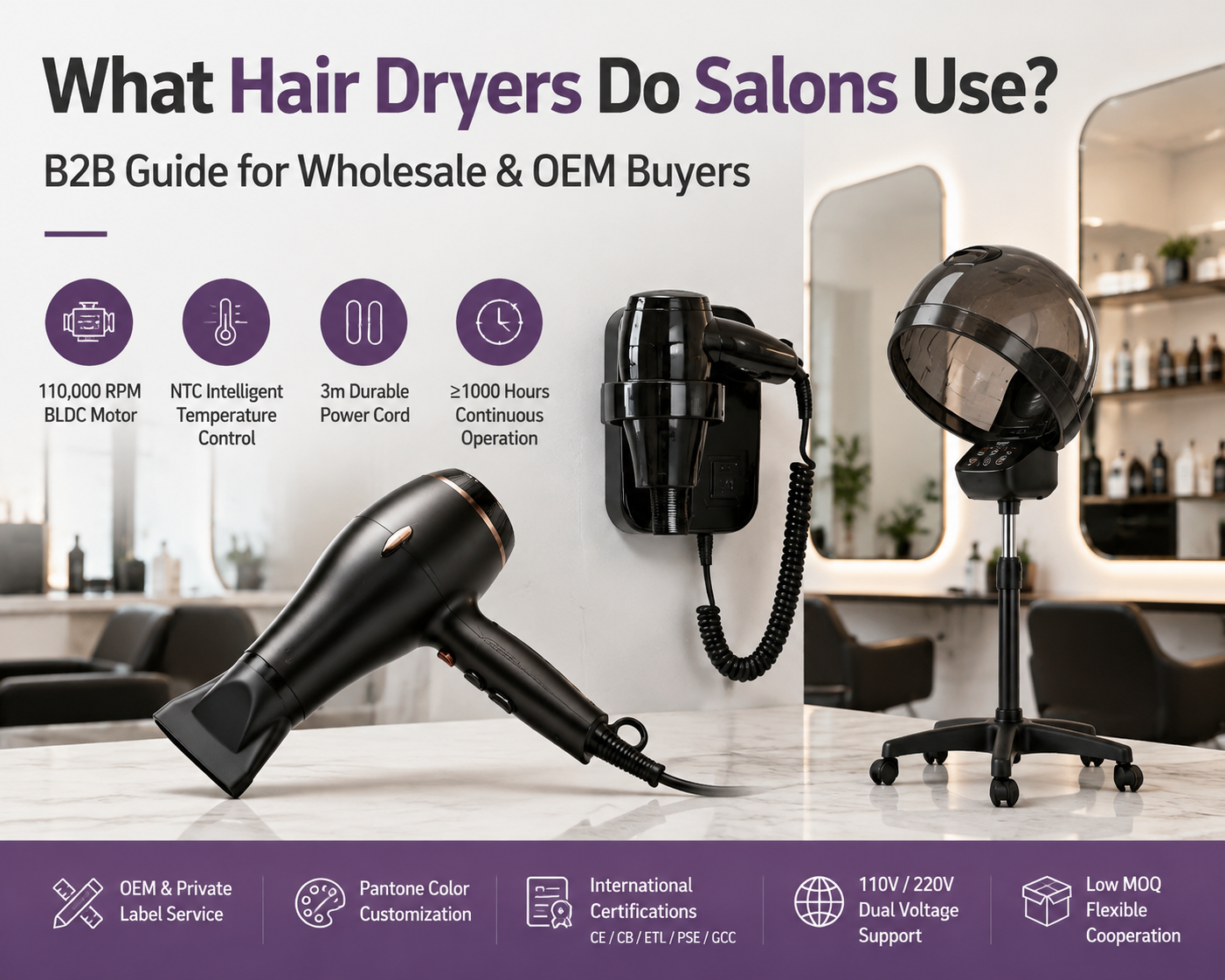
The three most common categories used in professional environments include:
Professional handheld hair dryers
Wall-mounted hair dryers for commercial applications
Salon hair dryer stands
Professional handheld hair dryers are the most common tools used by hairdressers because they provide flexibility for different styling services.
Stylists use handheld dryers for daily salon work, including:
Hair drying
Blowouts
Styling
Finishing treatments
Creating different looks for different hair types
Compared with basic home dryers, professional handheld models are usually designed with stronger airflow performance, adjustable heat settings, and features that support longer working hours.
For professional salon applications, common features include:
| Feature | Why It Matters for Hairdressers |
|---|---|
| Multiple speed and heat settings | Allows stylists to adjust airflow for different hair types and styling needs |
| Precision nozzle | Helps control airflow during detailed styling |
| Ionic technology | Can help reduce static and improve smoothness during styling |
| Ergonomic handle design | Improves comfort during repeated daily use |
Handheld dryers are often the main product category for brands and distributors developing professional styling equipment because they are widely used in different salon environments.
The key consideration is not only drying speed. Buyers should also evaluate motor performance, durability, noise level, and overall product reliability.
Wall-mounted hair dryers are commonly used in commercial environments where space organization and accessibility are important.
Unlike handheld dryers that are stored separately, wall-mounted models are fixed in a designated location. This makes them suitable for businesses that need easy access and a cleaner workspace.
Common applications include:
Hair salons
Beauty centers
Fitness facilities
Hospitality environments
Commercial bathrooms
Key advantages include:
| Advantage | Why It Matters |
|---|---|
| Space efficiency | Keeps work areas organized and reduces countertop clutter |
| Easy accessibility | The dryer stays in a fixed location and is ready to use |
| Professional appearance | Creates a cleaner and more organized environment |
| Improved organization | Some models include holders for additional styling tools |
For salons with limited workspace, a wall-mounted hair dryer can be a practical equipment choice.
However, the selection criteria are different from handheld salon dryers. Buyers should focus on installation requirements, product durability, safety features, and compatibility with the intended environment.
For more details about commercial wall-mounted solutions, explore our wall-mounted hair dryer solutions.
Salon hair dryer stands are another type of professional drying equipment, especially for applications that require hands-free operation.
They are commonly used for:
Hair treatments
Setting styles
Specialized salon services
Processes that require controlled drying time
Compared with handheld dryers, stand dryers allow stylists to focus on other parts of the service while the drying process continues.
Key benefits include:
| Feature | Application Value |
|---|---|
| Hands-free operation | Allows stylists to manage other tasks during treatment |
| Adjustable positioning | Improves flexibility for different clients and services |
| Suitable for treatments | Useful for processes requiring longer drying periods |
For buyers selecting salon equipment, stand dryers are usually evaluated based on the type of services offered rather than general drying performance.
A salon focused mainly on styling may prioritize handheld dryers, while treatment-focused businesses may require additional stand dryer solutions.
The best choice depends on how the equipment will be used.
A simple comparison can help buyers evaluate different options:
| Hair Dryer Type | Best Application | Main Advantage |
|---|---|---|
| Professional Handheld Hair Dryer | Daily styling and blow-drying | Flexible operation and styling control |
| Wall-Mounted Hair Dryer | Space-focused commercial environments | Organization and accessibility |
| Salon Hair Dryer Stand | Treatment and hands-free services | Convenient long-duration drying |
For salon chains, distributors, and wholesale buyers, the right product mix may include different dryer types depending on the target market and customer requirements.
For example:
A professional styling salon may prioritize handheld dryers.
A small salon with limited workspace may benefit from wall-mounted models.
A beauty facility offering treatments may require stand dryers.
Understanding the application first helps buyers avoid choosing products based only on specifications.
When choosing professional styling equipment, buyers should consider daily usage needs, market requirements, and long-term product reliability.
The right specifications help buyers balance drying performance, product reliability, and user experience.
For brands, distributors, and wholesale buyers, the following factors are important when evaluating professional hair dryer products.
The motor is one of the most important components of salon styling tools because it directly affects airflow performance, drying efficiency, and product durability.
Compared with standard consumer models, professional salon hair dryers are usually designed with motors that can support more frequent operation and consistent performance.
High-speed BLDC (Brushless DC) motor technology is increasingly used in premium hair dryer designs because it offers several advantages:
Efficient power conversion
Stable airflow performance
Lower vibration during operation
Longer service life compared with traditional motor structures
The motor should be selected based on the specific needs of the salon application.
For example:
| Application | Motor Performance Consideration |
|---|---|
| Professional salons | Stable airflow for repeated daily styling |
| Retail products | Balance between performance and market positioning |
| Private label projects | Motor specification based on target customers and price range |
Temperature stability is another important factor for professional hair styling.
Different hair types require different heat levels. Excessive heat may affect hair condition, while insufficient heat can reduce styling efficiency.
NTC (Negative Temperature Coefficient) temperature control technology helps monitor and adjust temperature changes during operation.
For professional applications, temperature control systems can help provide:
More stable heat output
Better consistency during styling
Improved user control for different hair types
Temperature control is another key feature that helps brands differentiate their salon hair dryer products.
A professional dryer should not only produce strong airflow. It should provide controlled performance for different styling scenarios.
Salon equipment is used much more frequently than household products. Therefore, durability is a key consideration for professional buyers.
When evaluating salon hair dryers, buyers should consider:
| Durability Factor | Why It Matters |
|---|---|
| Motor reliability | Supports repeated daily operation |
| Cable quality | Reduces damage caused by frequent movement |
| Housing materials | Improves product protection and lifespan |
| Internal component quality | Supports stable long-term performance |
Features such as reinforced power cables, ergonomic structures, and durable materials can improve the product experience in professional environments.
For wholesale buyers and distributors, reliable construction also helps reduce after-sales issues and improve customer satisfaction.
For global markets, professional hair dryer buyers need to consider electrical compatibility and certification requirements.
Different countries may have different voltage standards and compliance requirements.
Common considerations include:
| Requirement | Why Buyers Need to Check |
|---|---|
| 110V / 120V compatibility | Suitable for markets using lower voltage systems |
| 220V / 240V compatibility | Suitable for many international markets |
| CE certification | Common requirement for European markets |
| ETL certification | Important for certain North American markets |
| CB certification | Supports international electrical safety recognition |
| PSE certification | Relevant for the Japanese market |
| GCC requirements | Required for some Gulf region markets |
Certification requirements depend on the destination market and product category.
Professional buyers should confirm compliance requirements before starting product development or bulk purchasing.
Selecting salon styling tools is not only about choosing a product. For brands, distributors, and salon chains, supplier capability is also an important part of the decision.
A reliable supplier should understand product requirements, customization needs, and market regulations.
Many brands choose OEM or private label solutions when developing their own beauty equipment.
An experienced manufacturer can support different customization requirements, including:
Logo customization
Product appearance design
Packaging solutions
Color customization
Product specifications
For example, a beauty brand targeting professional salons may require a different product design compared with a retailer selling general consumer hair dryers.
The supplier should be able to adjust product solutions based on the target market.
MOQ (Minimum Order Quantity) is an important consideration for wholesale buyers.
The suitable MOQ depends on several factors:
| Factor | Impact on MOQ |
|---|---|
| Product model | Standard products may have different requirements from customized models |
| Customization level | Special colors, packaging, or designs may affect order quantity |
| Production process | Manufacturing requirements can influence minimum quantities |
Before starting cooperation, buyers should clearly communicate:
Target market
Expected order volume
Customization requirements
Packaging needs
This allows both the buyer and manufacturer to confirm a realistic production plan before moving forward.
For brands and private label sellers, product appearance can influence market positioning.
Common customization options include:
Pantone color matching
Logo printing
Packaging design
Accessory selection
Product configuration adjustments
Customization allows brands to create products that match their own market strategy instead of competing only through price.
A professional supplier should provide consistent product quality across different production batches.
When evaluating a manufacturer, buyers should consider:
Production experience
Quality control process
Testing procedures
Communication efficiency
Ability to support long-term cooperation
From a manufacturer’s perspective, successful professional hair dryer projects usually start with understanding the target market, usage environment, and compliance requirements before selecting product specifications.
Before selecting a professional salon hair dryer supplier, buyers can use the following checklist to evaluate whether a product matches their market requirements.
| Evaluation Item | Questions Buyers Should Ask |
|---|---|
| Target Market | Is the product designed for salons, retail, hospitality, or professional users? |
| Dryer Type | Does the application require handheld, wall-mounted, or stand dryer solutions? |
| Motor Performance | Does the motor provide stable airflow for the intended usage? |
| Temperature Control | Does the dryer support consistent heat management? |
| Voltage | Does the product match the destination market requirements? |
| Certification | Are required compliance standards available? |
| Customization | Can the supplier support logo, color, and packaging requirements? |
| MOQ | Does the production quantity match the business plan? |
Different salon environments may require different dryer solutions.
| Hair Dryer Type | Suitable Application | Main Advantages |
|---|---|---|
| Professional Handheld Hair Dryer | Daily salon styling | Flexible operation and styling control |
| Wall Mounted Hair Dryer | Space-focused commercial environments | Better organization and accessibility |
| Salon Hair Dryer Stand | Treatment services requiring hands-free operation | Convenient for longer drying processes |
For most professional buyers, the best solution depends on the application rather than a single “best” product.
A salon chain, beauty distributor, or private label brand should evaluate the target customers and usage environment before selecting a product category.
Developing a commercial hair dryer product usually requires several steps, from design and production to final customization.
A typical OEM product development process includes:
| Stage | Main Activity |
|---|---|
| Market Research | Define target customers and product positioning |
| Specification Planning | Select motor, design, voltage, and features |
| Prototype Development | Create and evaluate product samples |
| Testing and Adjustment | Verify performance and improve design |
| Certification Preparation | Prepare required market compliance documents |
| Mass Production | Manufacture products according to approved specifications |
A capable manufacturer helps buyers turn product ideas into finished products that meet market requirements.
This is especially important for brands that need customized products rather than standard off-the-shelf models.
Professional hairdressers usually use salon-grade hair dryers designed for frequent daily operation. The most common choices include handheld professional dryers for flexible styling, wall-mounted models for space-efficient applications, and specialized dryers for treatment services.
Professional salon hair dryers are designed for heavier usage and more consistent performance. They usually focus on stronger airflow, better temperature control, durability, and ergonomic design for long working hours.
Buyers should evaluate motor performance, airflow stability, temperature control, voltage compatibility, certification requirements, customization options, and supplier production capability.
Yes. Many commercial hair dryer manufacturers support OEM and private label projects, including logo customization, packaging design, product colors, and specification adjustments based on buyer requirements.
Certification requirements depend on the target market. Common certifications may include CE, CB, ETL, PSE, or GCC requirements depending on the destination country.
Professional hair dryers are commonly developed for different market voltage requirements, including 110V/120V and 220V/240V systems. Buyers should confirm voltage specifications before placing orders.
MOQ depends on product design, customization requirements, packaging, and production planning. Buyers should discuss MOQ requirements with the manufacturer based on their project needs.
Professional salons need reliable equipment that supports daily operations, while brands and distributors need suppliers that understand product development, customization, and international market requirements.
HUIPU provides professional hair dryer solutions for different commercial applications, including salon equipment, customized projects, and wholesale supply.
Whether you are developing a private label hair dryer line, expanding a salon equipment category, or sourcing commercial hair dryers for your market, selecting the right manufacturing partner is an important step.
Explore HUIPU’s professional salon hair dryer solutions and discuss your product requirements with our team.


