
Language
Views: 225 Author: HUIPU Product Engineering & Quality Control Team Publish Time: 2026-01-01 Origin: Site


How Far-Infrared Heat Works with Airflow and Temperature Control
Far-Infrared vs Traditional Hot-Air Drying: A Technical Comparison
How to Tell Whether a Hair Dryer Has Real Far-Infrared Value
Far-infrared hair dryers are often promoted as faster, gentler, and better for dry, frizzy, or damaged hair. But for many consumers, salons, distributors, and private-label buyers, the real question is more practical:
Does far-infrared technology actually make a difference, or is it just another hair dryer marketing label?
The honest answer is this: far-infrared technology can be meaningful, but only when it is engineered into a complete drying system. A hair dryer is not automatically better because it has a red light, an “infrared” label, or a premium design. Real performance depends on the heating structure, airflow design, temperature stability, motor performance, safety protection, attachments, and dryer use.
At HUIPU, we evaluate far-infrared hair dryers from a manufacturing and sourcing perspective. For B2B projects, we do not recommend judging a dryer only by the word “infrared.” We recommend checking the complete system: infrared heat support, motor type, airflow speed, heat settings, noise level, attachment design, certification support, sample testing, packaging claims, and bulk order consistency.
This guide explains how far-infrared hair dryer technology works, which claims are often oversimplified, and what buyers should check before choosing or sourcing a far-infrared hair dryer.
For a broader product selection framework, read our infrared hair dryer buying guide.
Far-infrared radiation has been studied in biological and medical contexts. Scientific literature commonly defines FIR as a wavelength range of about 3–100 μm, with 3–12 μm often discussed in biological and thermal studies.
However, a hair dryer is not a medical device. This article does not claim that far-infrared hair dryers can treat scalp conditions, stimulate cells, improve blood circulation, or repair damaged hair medically.
In hair dryer engineering, far-infrared should be evaluated as a heat-transfer and drying-comfort feature, not as a treatment function.
Far-infrared, often shortened as FIR, refers to a range of infrared radiation within the electromagnetic spectrum. In hair dryer design, the focus is not on medical therapy. The practical question is:
Can the dryer use far-infrared heat together with controlled airflow to create a more comfortable, efficient, and less harsh drying experience?
A far-infrared hair dryer may combine:
An infrared-supporting heating structure
Ceramic or infrared-emitting materials
Controlled hot airflow
Multiple heat and speed settings
Overheat protection
Ionic technology in some models
Diffuser or concentrator attachments
A motor system that determines airflow strength and drying efficiency
This is why buyers should never evaluate far-infrared technology as a single isolated feature. It should be judged as part of the full dryer system.
Based on HUIPU’s OEM/ODM experience, two dryers can both use the term “infrared” but perform very differently. One may have stable medium heat, balanced airflow, and comfortable drying distance, while another may simply add a visible light while still relying on harsh surface heat. The difference is not the label. The difference is the engineering behind the product.
One common misunderstanding is that a visible red light automatically means the dryer has real far-infrared performance.
That is not accurate.
Far-infrared radiation is not judged simply by what the user can see. A visible red light may be part of a product design, but red light alone does not prove meaningful far-infrared drying value. What matters is the heating source, material design, temperature control, and whether the dryer can deliver stable heat and airflow during real use.
For consumers, this means a product should not be trusted only because the shell glows red or the product page says “infrared.”
For salons, distributors, and private-label brands, this means the supplier should be able to explain the structure, specifications, testing method, and quality control behind the infrared claim.
A weak question is:
“Does this dryer have a red light?”
A better question is:
“How is far-infrared heat generated, controlled, and integrated with the airflow system?”

Traditional hair dryers mainly rely on hot airflow. Air is heated by an internal heating element, then pushed through the nozzle by the motor and fan. The drying process depends on heat, airflow, distance, time, hair thickness, water content, and user technique.
Far-infrared hair dryers still use airflow. They do not replace air movement. Instead, they add a radiant heat component that may help distribute heat in a different way from basic hot-air drying.
A well-designed far-infrared dryer should balance three things:
| System factor | Why it matters |
| Radiant heat | Supports a gentler heat-transfer story when properly engineered |
| Controlled airflow | Removes moisture and determines the real drying speed |
| Temperature stability | Reduces sudden overheating and harsh drying feel |
| Motor performance | Affects airflow strength, noise, lifespan, and product positioning |
| Attachments | Shape airflow for smoothing, curling, or focused styling |
| Safety design | Supports long-term reliability and compliance |
This is why a far-infrared dryer with poor airflow may still dry slowly. A far-infrared dryer with unstable temperature may still feel too hot. And a dryer with strong airflow but poor control may still create frizz, flyaways, or discomfort.
Far-infrared technology is useful only when it works together with a well-designed motor, airflow channel, heating system, temperature control, and drying modes.
Many product pages describe far-infrared hair dryers as drying hair “from the inside out.” This phrase is popular, but it can be misleading if taken literally.
Hair drying is not a simple process where the inner part dries first, and the outer part dries later. In real use, drying is affected by:
Hair thickness
Hair porosity
Water content
Air temperature
Airflow speed
Distance from the scalp
Nozzle or diffuser use
Drying time
Whether a heat protectant is used
How often the user moves the dryer
A more accurate explanation is:
Far-infrared heat may help create a gentler and more evenly distributed heating experience compared with harsh surface heat, but the final drying result still depends on the full dryer system and user technique.
This distinction matters because buyers are becoming more skeptical of exaggerated beauty technology claims. A professional manufacturer should be able to explain both the benefits and the limitations of the technology.
HUIPU’s own infrared buying guide also treats “dry hair from the inside out” as an over-absolute marketing phrase and explains that real results depend on motor, airflow, wattage, heat settings, nozzle, diffuser, and overall structure.
Far-infrared technology can be valuable, but it should not be presented as magic. The most trustworthy way to explain it is to separate what it may help with from what it cannot promise.
| Claim | More accurate explanation | What buyers should check |
| Faster drying | Far-infrared may support efficient drying, but airflow and motor power are still critical. | Motor type, airflow speed, heat settings, nozzle design |
| Less heat damage | It may create a less harsh heat feeling when the temperature is controlled well. | Temperature stability, low heat mode, and overheat protection |
| Less frizz | Frizz reduction often depends on infrared, ionic output, airflow direction, and attachments together. | Ionic function, concentrator, diffuser, heat/speed control |
| Better for damaged hair | It may be helpful for frequent users who need gentler drying, but it cannot repair damaged hair. | Low heat setting, drying distance, stable temperature |
| Suitable for all hair types | Different hair types need different airflow and heat combinations. | Adjustable speed, heat modes, attachment options |
| Healthier hair | A dryer can support gentler styling habits, but it cannot medically restore hair or scalp health. | Safe heat control, correct use, realistic product claims |
The most credible message is not:
“Far-infrared solves every hair problem.”
The stronger and more accurate message is:
Far-infrared can improve the drying experience when it is supported by proper engineering.

Far-infrared technology is not always the most important feature.
It may not be the priority if:
The target market only needs a basic, low-cost dryer
The product is used occasionally
The buyer cannot support a premium retail price
The dryer lacks stable temperature control
The airflow is too weak for the user group
The product cannot provide compliance documents
The packaging claim cannot be explained clearly after the sale
For some markets, motor reliability, safety certification, plug configuration, noise level, warranty, and durability may matter more than the infrared label.
This is especially important for hotel suppliers, importers, distributors, and private-label brands. A strong feature claim can help sell the product, but an unclear or unsupported claim can create customer complaints, return risk, or after-sales pressure.
A traditional hot-air dryer and a far-infrared hair dryer both use heat and airflow. The difference is not that one uses air and the other does not. The difference is how heat is generated, distributed, and controlled.
| Buyer question | Traditional hot-air dryer | Far-infrared hair dryer | What actually matters |
| Will it dry hair faster? | Depends mainly on heat and airflow. | May support efficient drying if airflow is strong enough. | Motor speed, airflow design, heat output |
| Will it feel less harsh? | Basic models may create strong surface heat. | May feel gentler when the temperature is stable. | Temperature control and drying distance |
| Is it better for frizz? | Depends on the airflow direction and heat level. | Often works better when paired with ionic technology. | Ionic output, nozzle, diffuser, hair type |
| Is it good for fine hair? | Strong airflow can disturb styling. | Useful only if low-speed control is available. | Adjustable airflow matters more than the label |
| Is it good for thick hair? | Needs strong heat and airflow. | Still needs high airflow to reduce drying time. | Motor performance and airflow speed |
| Is it suitable for salon use? | Depends on durability and comfort. | Useful if combined with a durable motor and ergonomic design. | Weight, noise, motor life, cable, attachments |
| Is it worth sourcing for retail? | Lower cost, easier positioning. | Stronger premium selling point if technically supported. | Product proof, packaging, certification, quality consistency |
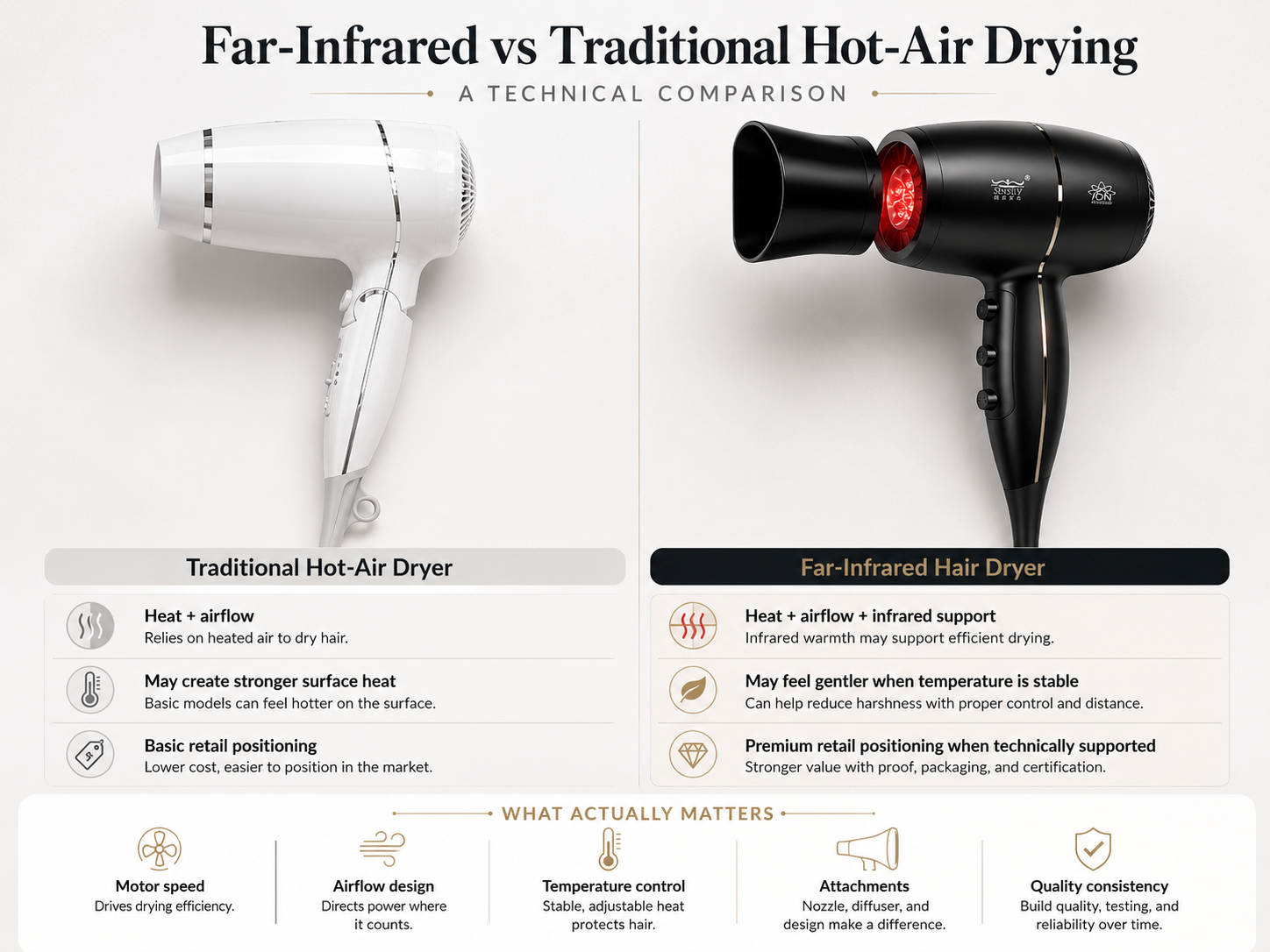
Different users expect different results from a far-infrared hair dryer. This is why one simple claim, such as “suitable for all hair types,” is too broad.
Fine hair users often worry about too much airflow, flat roots, flyaways, and a lack of volume. For this group, a far-infrared label is not enough.
They should check:
Low-speed mode
Gentle airflow option
Lightweight body
Concentrator nozzle
Stable low or medium heat
Easy-to-control buttons
For fine hair, airflow control may be more important than maximum power. If the dryer blows too strongly at the lowest speed, it may create flyaways or flatten the hair even if it includes far-infrared technology.
Curly and wavy hair users usually care about frizz control, curl definition, diffuser compatibility, and low-heat drying.
They should check:
Diffuser attachment
Cool shot function
Medium or low heat mode
Controlled airflow
Ionic function if frizz is a major concern
Dryer weight for longer styling sessions
For curly hair, far-infrared technology may be helpful, but the diffuser and airflow design are just as important.
Thick and long-haired users usually want faster drying. They may benefit from far-infrared technology, but only if the dryer also has strong airflow.
They should check:
Motor performance
Airflow speed
Heat stability
Nozzle concentration
Weight and balance
Noise level
For thick hair, far-infrared without enough airflow may not solve the main problem.
Damaged, bleached, or color-treated hair needs a gentler drying routine. Far-infrared may help create a less aggressive heat experience, but it cannot repair existing damage.
Users should check:
Low heat mode
Overheat protection
Stable temperature output
Proper drying distance
Heat protectant use
Avoiding prolonged drying on one section
For this group, the best result comes from technology plus careful technique.
Salon users care about more than hair feel. They also need durability, efficiency, comfort, and repeatable performance throughout the day.
They should check:
Motor lifespan
Airflow strength
Dryer weight
Noise level
Cable length
Filter cleaning design
Attachment durability
Warranty and spare parts
Certification support
For salons, far-infrared is useful only if the whole dryer can handle professional use.
Not every buyer should evaluate far-infrared hair dryers in the same way. A salon brand, hotel supplier, retail brand, and online seller may all need different priorities.
| Buyer type | What matters most | Role of far-infrared |
| Salon brand | Motor life, airflow, noise, weight, heat control, attachments | Premium care feature if the dryer supports daily professional use |
| Hotel supplier | Safety, durability, plug type, easy operation, low noise, and storage | Added comfort feature, but reliability and safety come first |
| Beauty distributor | Product range, stable supply, packaging, warranty, certification | Helps expand the premium hair care category |
| Private-label brand | Differentiation, MOQ, logo, packaging, product story, reviews | Useful selling point only if performance supports the claim |
| Travel retail buyer | Compact size, lightweight body, voltage options, and packaging size | Differentiation feature for compact premium products |
| Online seller | Clear specs, visual selling points, review stability, and after-sales risk | Must be explained clearly to avoid overpromising |
| Importer/wholesaler | Certification, price range, supply stability, replacement policy | Valuable if supported by compliance and bulk consistency |
A serious buyer should not evaluate a far-infrared dryer only by product images or marketing words. Instead, use a verification checklist.
A supplier should be able to explain how the infrared function is produced. Is it related to a ceramic coating, heating element, infrared emitter, or another structure?
If the answer is vague, the claim may be mainly marketing.
Far-infrared technology is less convincing if the dryer becomes too hot, fluctuates sharply, or lacks safe heat control.
Ask for:
Heat setting range
Temperature control method
Overheat protection
Testing conditions
Recommended drying distance
Drying performance depends heavily on airflow. A far-infrared dryer with weak airflow may still dry slowly.
Ask for:
Motor type
RPM
Airflow speed
Power rating
Noise level
Expected motor lifespan
Attachments affect the real user experience.
Important accessories include:
Concentrator nozzle for smooth styling
Diffuser for curly or wavy hair
Magnetic or secure-fit attachment system
Heat-resistant attachment material
For wholesale, retail, or private-label projects, certification is not optional. Buyers should ask which certifications can be supported for the target market.
HUIPU’s website states that the company supports B2B buyers with OEM/ODM development, factory-based production, quality control, and certifications, including CCC, CE, CB, GS, RoHS, CQC, and ETL.
Depending on the target market, buyers may need to check:
CE
RoHS
FCC
ETL
UKCA
CB
CCC
GS
Plug and voltage requirements
For B2B buyers, the best verification is not only a product brochure. Ask for sample testing.
Useful tests may include:
Drying time comparison
Temperature stability test
Noise test
Airflow test
Continuous operation test
Attachment durability test
Packaging drop test
Bulk order quality inspection
A reliable supplier should be comfortable discussing testing and quality control.
Far-infrared hair dryer technology is not just a beauty buzzword, but it should also not be treated as a magic feature. Its real value depends on engineering.
For consumers, salons, distributors, and private-label buyers, the most important question is not simply:
“Does this dryer have infrared?”
The better question is:
“Is the infrared function supported by stable temperature control, proper airflow, reliable motor performance, safe structure, and real testing?”
When these factors work together, far-infrared technology can become a useful part of a premium hair dryer system. When they do not, the infrared label alone is not enough.
Yes, far-infrared radiation is a real part of the infrared spectrum. In hair dryers, the key question is whether the infrared function is meaningfully engineered into the heating and airflow system. A product should not be judged only by the word “infrared” on the label.
No. Visible red light and far-infrared radiation are not the same thing. A red light may appear in the dryer design, but red light alone does not prove real far-infrared drying value. Buyers should check the heating structure, material, temperature control, and supplier explanation.
This phrase is often oversimplified. A more accurate explanation is that far-infrared heat may support a gentler and more evenly distributed heating experience, but drying still depends on airflow, temperature, time, hair type, and drying technique.
They may help create a less harsh drying experience when the temperature is well controlled. However, no hair dryer can eliminate heat stress. Heat damage risk still depends on temperature, distance, drying time, hair condition, and user habits.
No. A hair dryer cannot repair damaged hair in a medical or structural sense. It can only support a gentler drying routine when used correctly with proper heat control.
They solve different problems. Far-infrared focuses on heat transfer and drying comfort, while ionic technology is often used to reduce static and frizz. Many modern dryers combine both. The better choice depends on hair type, airflow design, and user needs.
It can be useful, but fine hair users should focus on low-speed control, moderate heat, lightweight design, and a concentrator nozzle. Too much airflow can disturb fine hair even if the dryer has infrared technology.
It may help when combined with a diffuser, controlled airflow, and stable heat. For curly hair, the attachment and speed setting are often just as important as the infrared feature.


