
Language
Views: 0 Author: Site Editor Publish Time: 2026-06-03 Origin: Site


Do all hotels have hair dryers? Not always — but today, a reliable hotel hair dryer is no longer viewed as a small extra. For many guests, it is part of the basic in-room experience.
For hotel owners, Airbnb hosts, B&B operators, serviced apartment managers, and hospitality buyers, the real question is not only whether a room should include a hair dryer. The more important question is:
What kind of hotel hair dryer should you provide so guests can actually rely on it?
As a hotel hair dryer manufacturer, we see that buyers usually ask about cost control, durability, guest experience, bathroom space, plug type, socket design, wall-mounted installation, and long-term replacement cost before making a purchasing decision. These are the right questions, because a hair dryer used in hospitality is not the same as a household appliance used occasionally at home.
A hotel bathroom hair dryer must be safe, easy to use, suitable for repeated guest turnover, compatible with local voltage and plug standards, and durable enough to reduce maintenance overhead.
Not all hotels have hair dryers in the room. Many mid-range hotels, business hotels, chain hotels, resorts, and luxury hotels usually provide them. However, some budget hotels, older motels, hostels, guesthouses, and short-term rentals may not provide a hair dryer in every room. Some properties only offer one upon request at the front desk.
From a guest’s point of view, this creates uncertainty. A traveler may wonder whether they need to pack their own dryer, whether the room dryer will be strong enough, or whether the front desk will have one available when needed.
From a hotel operator’s point of view, this is more than a convenience issue. If guests now expect a hair dryer but cannot find one, or if the dryer is weak, broken, unsafe-looking, or difficult to use, the property may create avoidable frustration.
The hospitality standard is shifting from:
“Does the room have a hair dryer?”
to:
“Can guests rely on the hair dryer without calling the front desk?”
That difference matters.
Hair dryer expectations vary by property type. A luxury hotel and a hostel do not need the same solution, but both should understand what their guests expect.
| Accommodation Type | Typical Guest Expectation | Recommended Hotel Hair Dryer Setup |
| Budget hotel/motel | Basic convenience, simple use, no missing items | Durable wall-mounted hotel hair dryer with anti-theft design |
| Business hotel | Fast drying, reliable use before meetings or travel | Higher airflow model with stable heat and low maintenance |
| Resort/wedding hotel | Better styling support and comfort | Premium or high-speed option, possibly with ionic features |
| B&B / boutique hotel | Home-like comfort with controlled investment | Cost-effective, reliable dryer with consistent room setup |
| Serviced apartment / Airbnb | Flexible use and easy storage | Portable dryer or secured wall-mounted option depending on room layout |
| Gym/spa / shared bathroom | Frequent use and easy maintenance | Heavy-duty wall-mounted hair dryer for hospitality environments |
For B2B buyers, this table highlights an important point: the best hotel hair dryer is not always the most expensive one. The right choice depends on the property type, guest profile, bathroom layout, maintenance routine, and replacement cycle.
International guests may travel with their own hair dryers, but that does not always solve the problem. Voltage, plug type, wattage, and bathroom power rules differ by market. A dryer designed for one country may not be suitable for another.
For hotels, this is why locally compatible in-room hair dryers are important.
Before purchasing, hospitality buyers should confirm:
Local voltage requirements, such as 110V, 220V, or 230V
Plug type for the target market
Whether the dryer will be used in the bathroom or outside the bathroom
Whether a wall-mounted hair dryer with a socket is required
Whether the socket is for shaver use, appliance use, or a specific local standard
Whether the hotel’s electrical system can support the selected wattage
Whether the product includes overheating protection or thermal safety features
A common purchasing mistake is choosing only by wattage. Higher wattage can improve drying performance, but it must match the local electrical environment and property conditions. For older hotels or high-room-count projects, wattage, safety, and energy efficiency should be considered together.
A locally compatible hotel bathroom hair dryer helps reduce uncertainty for international guests and avoids relying on guests’ personal travel appliances.
Guests rarely think in technical terms like RPM, thermal control, or maintenance overhead. They judge the dryer by simple experience:
Is it there?
Does it work?
Does it dry hair fast enough?
Is it easy to use near a mirror?
Does it look clean and safe?
Does it match the room standard?
For hotels, these simple expectations become purchasing requirements.
A good in-room hotel hair dryer should meet several basic standards before any premium features are considered.
A front-desk backup dryer is useful, but it should not be the main solution for standard rooms. Guests often need a dryer after showering, before going out, or before business meetings. Waiting for housekeeping or calling reception creates friction.
For hotels with high turnover, placing a reliable dryer in each room can reduce front-desk requests and improve operational efficiency.
Weak airflow is one of the most common reasons guests feel disappointed. A low-wattage dryer may save on purchase cost, but if it takes too long to dry hair, guests notice.
Drying performance depends on more than wattage. Motor efficiency, airflow design, heat stability, and air outlet structure all matter. A well-designed hotel hair dryer should balance drying speed, noise, energy efficiency, and safety.
This is often overlooked during purchasing.
A wall-mounted hair dryer for hotels may look practical, but if the installation point is too far from the mirror, or if the cord is too short, guests may struggle to use it comfortably.
Before buying, hotels should consider:
Bathroom mirror position
Power outlet location
Cord length
Coiled cord security
Mounting height
Whether right-handed and left-handed guests can use it easily
Whether the dryer creates counter clutter
A space-saving design is valuable, but it should not reduce usability.
Guests may not inspect technical details, but they quickly notice dust, discoloration, damaged cords, a burned smell, loose wall bases, or hair tangling in intake vents.
For hospitality use, easy cleaning matters. A hotel bathroom hair dryer should ideally have a smooth surface, a practical air inlet design, and a structure that housekeeping teams can check quickly during room turnover.
Hotels should also inspect:
Air intake condition
Cord wear
Plug condition
Wall mount stability
Signs of overheating
Loose screws or broken holders
Safety and cleanliness are not only product issues. They are also maintenance issues.
A household dryer may be used by one family. A hospitality dryer may be used by hundreds of different guests over its life cycle. This changes the product requirement.
Hotels should consider durability in terms of:
Housing strength
Switch life
Cord durability
Mounting base strength
Motor stability
Replacement frequency
Ease of maintenance
In high-turnover properties, frequent replacement cycles can increase lifecycle cost even if the initial purchase price is low.
Not every property needs a premium high-speed hair dryer. However, upgraded features can be valuable when they match the room rate, brand positioning, and guest profile.
For budget hotels and motels, the priority is usually:
Durability
Anti-theft wall mount base
Easy cleaning
Stable performance
Controlled cost
For business hotels, buyers may care more about:
Faster drying
Lower noise
Stable heat output
Reliable daily use
Reduced maintenance overhead
For resorts, wedding hotels, boutique hotels, and luxury rooms, upgraded features may be worth considering, such as:
Brushless DC Motor for longer service life and more stable performance
Higher RPM motor design for stronger airflow, if supported by the product specification
Negative Ion Generator for a smoother hair-drying experience
Intelligent Thermal Control for more stable temperature management
Better exterior design to match the room style
The key is not to add technology for marketing only. Every feature should answer a business question:
Does this feature improve guest experience, reduce complaints, extend product life, or support the hotel’s room positioning?
For example, a commercial hair dryer for luxury hotels may justify higher investment if it supports stronger airflow, lower noise, better aesthetics, and longer lifecycle cost control. But the same level of specification may not be necessary for every budget property.

A hotel hair dryer should not be selected only by unit price. For procurement teams, the better question is:
What is the total cost and guest impact over the product’s service life?
Below is a practical checklist from a manufacturer’s perspective.
| Checklist Item | Why It Matters for Hotels |
| Airflow and drying efficiency | Prevents guest frustration from weak airflow |
| Wattage and voltage compatibility | Helps match local electrical conditions |
| Plug type | Required for different export markets |
| Socket requirement | Important for wall-mounted models with shaver or power socket design |
| Wall-mounted or portable setup | Affects space, theft risk, and flexibility |
| Anti-theft wall mount base | Reduces missing units and asset loss |
| Coiled cord security | Helps control cord placement and guest use |
| Space-saving design | Reduces bathroom counter clutter |
| Safety protection | Helps reduce overheating or short-circuit risks |
| Easy-clean air inlet | Helps prevent dust and hair buildup |
| Durability | Reduces frequent replacement cycles |
| Energy efficiency | Supports operating cost control |
| Maintenance overhead | Affects housekeeping and engineering workload |
| Guest satisfaction | Impacts the perceived quality of room amenities |
This checklist is especially useful for hotel chains, B&B operators, boutique hotels, and hospitality project buyers comparing different supplier options.
A low-priced dryer may seem attractive during procurement, especially for projects with many rooms. However, the cheapest option is not always the most cost-effective option.
Low-quality hair dryers can create hidden costs through:
More frequent replacement cycles
More room maintenance reports
Higher housekeeping inspection workload
Guest complaints about weak airflow
Units missing from rooms
Damaged cords or wall mounts
Higher front-desk request volume
Mismatch with the hotel’s room rate and brand image
For example, if a dryer has weak airflow, guests may use it for longer. If the housing is fragile, the replacement rate may increase. If the wall-mounted base is loose, the engineering team may need to repair it repeatedly. If the cord is too short, guests may complain even if the dryer technically works.
This is why lifecycle cost matters.
A hotel should not only ask:
“How much does one dryer cost?”
It should also ask:
“How long will it last, how often will it need attention, and how will guests feel when using it?”
For B2B buyers, this is the difference between purchase price and total operating cost.
Different properties need different purchasing strategies.
A budget motel may not need a premium ionic dryer in every room, but it does need a reliable, durable, wall-mounted hotel hair dryer that saves space and reduces theft risk.
A boutique hotel may not want a basic low-wattage model if the room design and nightly rate create higher guest expectations. In that case, cost-effective high-speed hair dryers for boutique hotels may be worth evaluating.
A B&B may look for consistent room setup and controlled investment. Instead of focusing only on “bulk buy ionic hair dryers for B&Bs,” the better question is whether the selected model is easy to replace, simple for guests to use, and reliable across multiple rooms.
A luxury hotel may need a commercial hair dryer for luxury hotels that supports stronger airflow, lower noise, premium appearance, and better user comfort.
A spa, gym, or shared hospitality bathroom may require a heavy-duty wall-mounted hair dryer for hospitality environments, where anti-theft design, safety, and maintenance are more important than portability.
The best purchasing decision balances five factors:
Guest experience
Does the dryer feel reliable, comfortable, and appropriate for the room?
Durability
Can it handle repeated use and frequent guest turnover?
Space control
Does it reduce counter clutter and fit the bathroom layout?
Electrical compatibility
Does it match the local voltage, plug type, and socket requirement?
Lifecycle cost
Does it reduce replacement, maintenance, and operational burden over time?
Hotels that only optimize for initial price may save money at the beginning but spend more later through maintenance overhead and replacement frequency.
A hotel hair dryer is not the most expensive item in a guest room, but it can strongly affect how guests perceive the room’s practicality.
Guests usually do not praise a hotel simply because a dryer exists. But they do notice when it is missing, weak, dirty-looking, difficult to use, unsafe, or inconsistent with the room standard.
For hotel procurement teams, the best approach is to define the room scenario first:
What type of property are we supplying?
Who are the guests?
Where will the dryer be installed?
What plug type and voltage are required?
Is a socket needed?
Is theft prevention important?
How often will rooms turn over?
What level of guest experience do we need to match?
Once these questions are clear, choosing the right model becomes much easier.
As a B2B hair dryer manufacturer, HUIPU supports hospitality buyers with hotel hair dryer solutions for guest rooms, bathrooms, B&Bs, serviced apartments, wall-mounted installations, and bulk hospitality projects. Depending on the project, buyers can evaluate models by installation type, plug requirement, socket design, durability, airflow, safety features, and customization needs.
The goal is simple:
Provide a dryer guests can use confidently — and hotels can manage efficiently.
A reliable hotel hair dryer should not be treated as a minor accessory. It is part of the guest room experience, the bathroom layout, the maintenance plan, and the hotel’s long-term operating cost.
The question “Do all hotels have hair dryers?” is only the starting point.
For accommodation businesses, the more valuable question is:
“Are we providing the right hotel hair dryer for our guests, property type, and operating conditions?”
If your property is choosing hair dryers for new rooms, renovation, bulk replacement, or hospitality distribution, focus on:
Hotel hair dryer quality
Guest expectations
Wall-mounted or portable setup
Local voltage and plug type
Socket requirement
Durability
Space-saving design
Maintenance overhead
Lifecycle cost
Long-term supplier support
A well-selected hotel bathroom hair dryer can reduce guest uncertainty, control replacement costs, and support a more consistent room experience.
In many hotels, guests can request a hair dryer or a replacement from the front desk if the in-room unit is missing, broken, or not powerful enough. However, from a hotel management perspective, front-desk requests should be a backup solution, not the main hair dryer strategy.
If many guests need to request a better dryer, it may suggest that the current in-room hair dryer quality does not meet guest expectations. Hotels can reduce service requests by providing reliable dryers directly in the room.
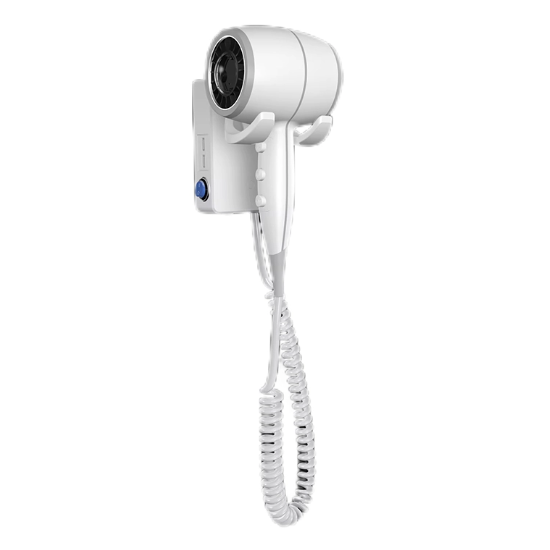
Hotels often use wall-mounted hair dryers because they save space, reduce counter clutter, support fixed storage, and help prevent missing units. A wall-mounted hair dryer for hotels can also make housekeeping checks easier because the dryer has a fixed location.
For budget hotels, motels, gyms, spas, and high-turnover rooms, a wall-mounted hotel hair dryer with an anti-theft wall mount base or coiled cord security can help reduce asset loss and maintenance issues.
However, installation position matters. If the dryer is too far from the mirror or the cord is too short, guest experience may suffer.
Some 5-star hotels and luxury properties may provide Dyson, high-speed, ionic, or premium hair dryers, but not every luxury hotel needs to follow one specific consumer brand.
The better purchasing question is whether the dryer matches the hotel’s guest profile, room rate, design standard, durability requirement, and maintenance budget.
For luxury hotels, upgraded features such as a brushless DC Motor, a negative ion generator, intelligent thermal control, lower noise, and stronger airflow may be worth considering when they improve the guest experience and support long-term reliability.
Neither option is always better. The right choice depends on the property type and room layout.
Wall-mounted hair dryers are often better for budget hotels, motels, shared bathrooms, gyms, and properties that need space-saving design and anti-theft control.
Portable hair dryers may be better for luxury rooms, serviced apartments, Airbnb units, or boutique hotels where flexibility and room design are more important.
Hotels should compare guest experience, theft risk, maintenance overhead, installation cost, and lifecycle cost before choosing.
Luxury hotels do not always need Dyson-branded dryers, but they do need hair dryers that match guest expectations. For premium rooms, guests may expect stronger airflow, better appearance, lower noise, smoother drying, and more comfortable handling.
High-speed or ionic hotel hair dryers can be valuable for luxury hotels, resorts, wedding hotels, and boutique properties when they support the room positioning. However, hotels should still evaluate durability, plug type, socket design, safety features, and maintenance requirements before purchasing.


